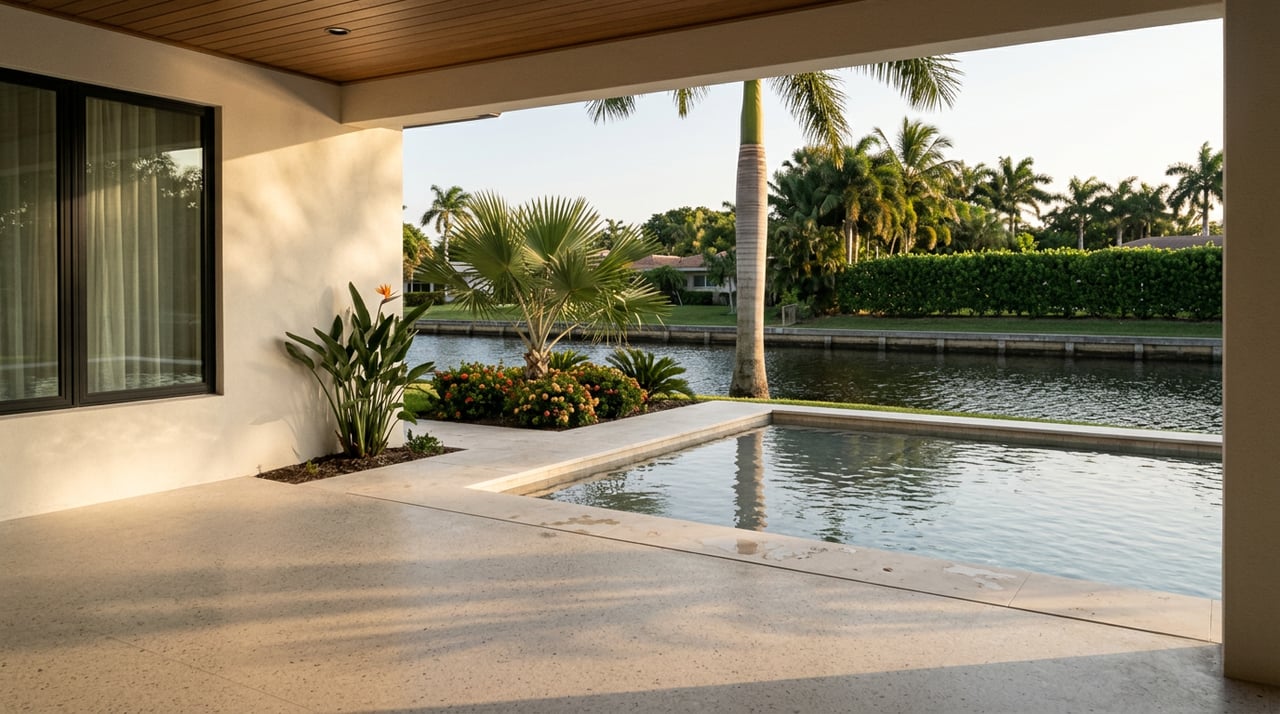
Why the Coral Gables Waterfront Gap Keeps Widening, Not Closing
August 20, 2026
August 20, 2026
Walk a dock in Cocoplum or along one of the canal streets off Snapper Creek and the seawall usually looks fine. Concrete cap, clean line, maybe a little staining near the waterline that reads as cosmetic. What you can't see from the yard is the tieback, the steel rod anchoring the wall panel to the ground behind it. A lot of those walls went in during the 1960s and 70s using galvanized steel tiebacks, and corrosion failures can show up roughly 30 to 50 years in. The wall can look structurally sound the week you tour the house and still need a marine engineer's report before a lender or insurer signs off.
That single detail, invisible from a listing photo, is a small example of a much bigger pattern in this market. If you've been comparing Coral Gables neighborhoods using the median price you saw on a portal, you're missing the part of the story that actually explains why waterfront here keeps getting more expensive relative to everything else, not less.
In most mature cities, the price difference between a scarce amenity, like water access, and the ordinary inland housing stock around it tends to compress over time. Inland renovation catches up, new construction narrows the quality gap, and buyers who can't get the scarce thing settle for something close enough. That's the pattern most market commentary assumes for a city as built-out as Coral Gables.
Coral Gables hasn't followed it. A Miami-based advisory firm's Q1 2026 market analysis tracked price per square foot in Gables Estates against resale pricing east of US-1, the inland core of the city, across the same decade:
| Segment | 2016 $/sf | 2026 $/sf | Multiple vs. inland |
|---|---|---|---|
| East of US-1 (inland resale) | $456 | $1,050 | 1.0x |
| Gables Estates (waterfront) | $1,185 | $3,100 | 2016: 2.6x / 2026: 3.0x |
Inland prices more than doubled, which is exactly what you'd expect in a hot South Florida decade. Waterfront in Gables Estates didn't just keep pace. It pulled further ahead, from roughly two and a half times the inland number to three times it. Cocoplum told a similar story from a lower starting point, up about 175 percent since 2016 against Gables Estates' 162 percent, because Cocoplum entered the decade priced more like a mid-tier canal community and got re-rated upward as buyers who couldn't get into Gables Estates or Old Cutler Bay treated it as the next best deep-water option.
If waterfront were simply luxury demand riding the same wave as everything else, that multiple should have held steady or narrowed. It widened. Something structural is keeping the water premium from being competed away, and it isn't just taste.
The first piece of that structure is physical, not financial. Canal depth and bridge clearance determine what size vessel can reach open water from a given dock, and that single variable does more to set price than square footage or even lot size once you're inside the waterfront tier. A property with a fixed bridge between the dock and Biscayne Bay caps the boat size a buyer can ever run, permanently, regardless of what they're willing to spend on the house. A property with no fixed bridge and confirmed depth at mean low water opens the door to serious yachts, and that access can't be built or subdivided into existence. The city can't add more no-bridge frontage on the Coral Gables Waterway. That scarcity is fixed in a way that scarcity of, say, five-bedroom inland houses is not, because inland lots can eventually be redeveloped or expanded. A dock's clearance to the bay cannot.
The second piece is the seawall problem itself, and it does more than create repair bills. It filters the buyer pool in a way that reinforces the premium rather than eroding it.
Marine contractors working the Cocoplum and Snapper Creek canals report that most of the seawall failures they see follow the same pattern: tieback corrosion in aging walls, often paired with backfill loss through the panel joints behind the wall. The repair path, helical anchoring combined with polyurethane foam injection, runs meaningfully cheaper than full replacement, but full seawall replacement where it's needed has been quoted at roughly $1,000 to $1,500 per linear foot by local professionals summarizing recent projects. On a property with 100 feet of canal frontage, that's a six-figure line item hiding behind a wall that looked fine on the first walk-through.
Seawall, dock, and dredging work in Miami-Dade can involve permitting and review, which adds real time to any project a buyer might plan. Coral Gables' own permitting review adds a second layer on the aesthetic side. As Seawall Repair Miami notes, the city's Board of Architects reviews exterior work closely, including finish details on caps and coping, which is part of what has kept the canal streets visually consistent for decades but also means a seawall repair here isn't a quick call to a marine contractor. It's a project with a design review step attached.
None of that stops transactions. It does mean that buyers who aren't prepared to underwrite maintenance risk, permitting timelines, and potential six-figure repairs self-select out of the waterfront tier before they ever make an offer. Fewer qualified buyers chasing a fixed supply of no-bridge, deep-water lots is a textbook way to sustain a premium rather than shrink it.
Gables Estates and Cocoplum both operate under HOA or club governance rather than open city streets, and in parts of Gables Estates that includes guarded gates and reported water patrols funded by residents. That governance layer does two things at once. It protects the streetscape and security that buyers are paying for, and it adds another filter on top of price. National coverage has ranked Gables Estates among the priciest neighborhoods in the country.
This is why two market snapshots from the same summer can look like they're describing different cities. Broad, automated home-value tracking measured over the three months ending in May 2026 put the median Coral Gables single-family sale at $1.7 million, essentially flat year over year, with homes taking about 83 days to sell on average. A local brokerage quote reported by Miami Today in June 2026 described a seller's market with a roughly $2.7 million median and contracts signed within about 26 days. Both can be accurate. The automated median blends every inland resale, teardown-value listing, and starter home into one number. The brokerage quote is describing what's actively transacting at the top of the market, where waterfront and newer construction concentrate. Neither figure is lying. They're measuring different slices of a city that, as this data shows, is really several micro-markets wearing one median.
If you're comparing Coral Gables to another neighborhood using a single portal number, you're comparing an average of these very different segments to whatever similarly blended number the other neighborhood produces. That's not a useful comparison if what you actually want is a bay-access dock or a walkable inland block near Miracle Mile.
If a waterfront lot is on your list, a few questions do more work than the list price:
The waterfront premium in Coral Gables isn't holding steady because buyers love boats more than they used to. It's holding, and widening, because the supply of true deep-water, no-bridge frontage can't grow, the maintenance and permitting burden filters out casual buyers, and governance in the top enclaves adds one more gate most other Miami-Dade neighborhoods don't have. Understanding which of those forces applies to a specific lot is the difference between paying a fair premium for scarcity and paying full waterfront price for a canal that can't actually get a boat larger than a dinghy to the bay.
Does a newer seawall mean lower risk? Age matters, but so does the original construction method. A wall from the 1960s or 70s with galvanized tiebacks carries different risk than a wall reinforced more recently with helical anchoring, even if both look similar above the waterline. Ask for the engineering history, not just a build year.
Is a waterfront lot without direct dockage still worth a premium? Often yes, since water view and privacy carry value on their own, but the multiple is smaller than what a true deep-water, dockable lot commands. Treat view-only waterfront as its own category when you compare pricing, not as a discount version of a boating lot.
If you're weighing a waterfront purchase against an inland Coral Gables block, or trying to figure out what a specific canal lot is really worth once you account for seawall age and bridge clearance, Eric Firestone Real Estate can walk the numbers with you before you write an offer. Reach out to schedule a Coral Gables waterfront consultation.
This article is general information, not legal, tax or financial advice. Consult a qualified professional about your situation.

Get assistance in determining current property value, crafting a competitive offer, writing and negotiating a contract, and much more. Contact me today.