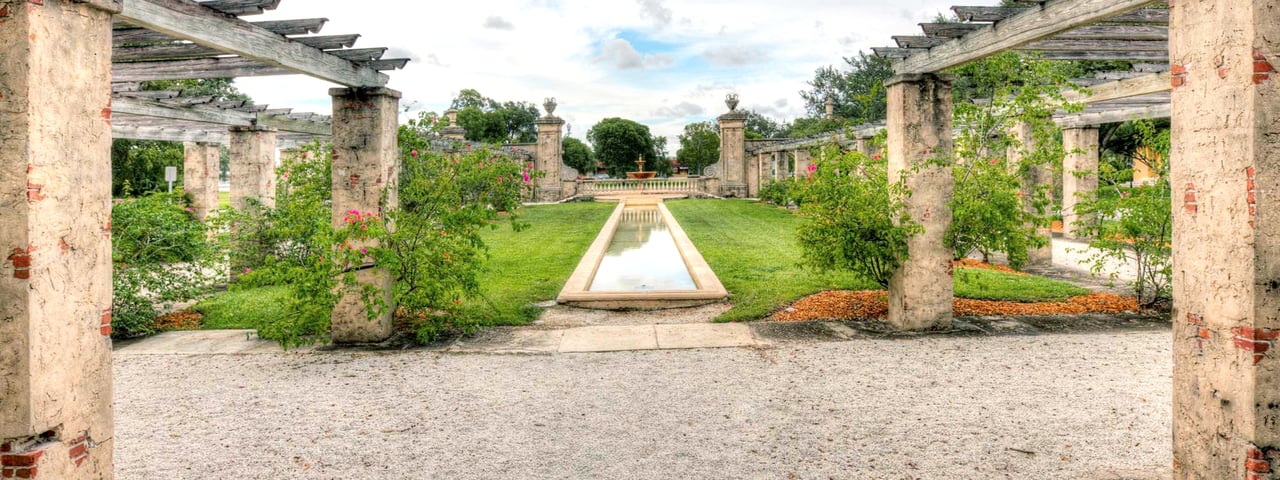
Coral Gables at a Glance
Coral Gables is a city about 6 to 7 miles southwest of downtown Miami, founded by George Merrick and known as "The City Beautiful." And, what a beautiful city it is! It was incorporated on April 29, 1925, and covers 12.9 square miles, with about 49,600 residents according to the 2025 Census estimate. Miami International Airport is about 4 miles away, and the city is home to my alma mater, the University of Miami. (It's all about the U!) The main ZIP codes are 33134 and 33146. The southern waterfront areas use 33156 and 33158, and some Coral Gables addresses fall in 33143 and 33133, so it is worth confirming the city line for any residence you are considering.
Who Coral Gables Fits
Coral Gables tends to suit people who want their surroundings to feel deliberate. Buyers drawn to Mediterranean Revival architecture and a protected streetscape often see the city's preservation culture as part of what they are choosing. Professionals relocating for work often want a defined sense of place, with Miracle Mile, the Biltmore and Venetian Pool close at hand. Homeowners moving up often want a residence with more room and more character. Homeowners rightsizing within the city can simplify how they live without leaving a place they already know. It may be a less natural fit if you want complete freedom to change a residence's exterior, since historic status or exterior changes may involve city review. If you want more land and a quieter setting, see my Pinecrest guide.
Coral Gables Neighborhoods
Coral Gables is made up of distinct neighborhoods, and the differences between them come down to water access, gates, lot character and architectural style. Two residences a mile apart can offer very different settings, so I look at each area on its own terms.
- Gables Estates: Gables Estates is a guard-gated neighborhood where most residences sit on the water behind a staffed entrance, so waterfront position and lot orientation are central to how each property is compared.
- Cocoplum: Cocoplum is a gated neighborhood with both waterfront and inland estates. Whether a residence sits on the water or farther inland is one of the first distinctions I review with a client here.
- Gables by the Sea: Gables by the Sea is known for its bayfront homes. Because each lot relates to the water differently, I evaluate these residences individually.
- Riviera: Riviera is a historic area with Mediterranean Revival homes and mature landscaping. Its established streetscape is a large part of its character, and any exterior plans should account for the city's review process.
- Hammock Oaks: Hammock Oaks is a gated, low-density neighborhood, with fewer homes spread across its streets than in more compact parts of the city.
- North Gables: North Gables has smaller lots and homes, which often make it a more accessible way into the city.
- The Biltmore area: Located inland near the historic Biltmore Hotel, this area features mostly Mediterranean-style and colonial homes.
- South Gables: South Gables tends to have the largest sized lots, with multiple internal neighborhoods as well as some that reach the water.
- The Historic Villages: The Historic Villages are a collection of themed residences that offer an architectural alternative to Mediterranean Revival. George Merrick planned 14 international villages, and seven were built between 1925 and 1927: Chinese, Dutch South African, French City, French Country, French Normandy, Florida Pioneer (also called Colonial) and Italian. They were designed by well-known architects of the era, including Mott Schmidt, Marion Sims Wyeth and Henry Killam Murphy. French Country sits on the 500 block of Hardee Road and French City on the 1000 block, while Dutch South African runs along LeJeune Road and San Vicente Street. On Santa Maria Street, five Florida Pioneer homes are part of the Santa Maria Street Historic District (2007). These residences rarely come to market, and any exterior changes involve city review. If historic architecture interests you, I would welcome a conversation about what is available and what owning one involves.
If you are weighing more than one of these areas, I am glad to walk you through how they compare for your plans.
How Much Is a House in Coral Gables?
As of November 2026, the median single-family sale price in Coral Gables over the past 180 days was $2,395,000, up 6.4% from the same period a year earlier, based on my MLS data. Single-family sales ranged from $750,000 to more than $25 million. The median condo sale price was $562,500, up 7.1%. Single-family homes are selling faster than a year ago, with a median of 42 days on market, down from 51. Condos are taking longer, at a median of 63 days, up from 51, which in my view reflects Florida’s newer condo safety rules on building inspections and reserves. A citywide median describes the market as a whole, not any one residence, area or "village." Prices vary widely by neighborhood, lot size and waterfront access, so a waterfront estate behind a gate and a residence on an inland street can sit far apart in value. That is why I price each residence against its closest real comparables rather than a citywide figure. If you would like to know where your own residence stands today, I invite you to request a private home valuation.
Why Is Coral Gables So Expensive?
Coral Gables is expensive in part because the city closely controls what gets built, and in my view, because land here is limited. Every new home, addition, pool, roof tile and sign goes through the city's Board of Architects under Zoning Code design standards. The city also has formal Mediterranean-style design standards, and building applications require a tree survey and a tree protection plan. The city’s character also goes beyond Mediterranean Revival. George Merrick planned 14 themed international villages, and seven were built between 1925 and 1927, including the Chinese, French Normandy, Dutch South African and Italian villages. Homes like these cannot be recreated today, and that scarcity is part of what buyers are paying for. Together, these rules keep the city's architecture and streetscape consistent over time.
In my professional view, four things keep demand steady while supply stays tight: limited land, the waterfront estates, the tree canopy and the central location near the University of Miami. Buyers are paying for a setting that is protected from rapid change, and that setting cannot easily be reproduced elsewhere.
From my experience, anyone planning a renovation should treat design review and tree requirements as part of the timeline and the budget from the start. I would rather you understand the process before you commit to a plan than discover it afterward.
Coral Gables Property Taxes and Amendment 3
Coral Gables property taxes start with a city operating millage of 5.559 mills, which has been unchanged for 12 straight years. When county, school and other levies are added, the total is roughly 20.5 mills before exemptions. That total is an estimate, and your actual bill depends on your residence and its exemptions.
Florida voters approved Amendment 3 on November 3, 2026, with about 62% voting yes. It raises the non-school homestead exemption to $150,000 in 2027 and $250,000 in 2028. School taxes are unchanged. I walk through what it means in my Amendment 3 series on YouTube.
For figures specific to your residence, please check with the Miami-Dade Property Appraiser and a tax professional.
Coral Gables Schools
Coral Gables is served by Miami-Dade County public schools, and the city says all but one of its public schools are rated A or B. Under the 2024-25 Florida state grades, Coral Gables Senior High, Coral Gables Preparatory Academy K-8, George Washington Carver Elementary, West Laboratory Elementary and International Studies Preparatory Academy each received an A. Ponce de Leon Middle received a B, up from a C.
School assignment depends on the specific address, so a residence near one of these schools is not necessarily zoned for it. Please confirm zoning with Miami-Dade County Public Schools before you make a decision.
Coral Gables also has a wide range of private schools within the city limits, from early childhood programs through high school:
- The Growing Place School (preschool to grade 5), 536 Coral Way
- Riviera Day and Preparatory School (preschool to grade 8, Day School campus), 6800 Nervia Street
- Saint Philip’s Episcopal School (pre-K to grade 5), 1121 Andalusia Avenue
- Saint Theresa Catholic School (pre-K to grade 8), 2701 Indian Mound Trail
- Banyan Day School (pre-K and kindergarten), 340 Palermo Avenue
- Brito Miami Private School (grades 4 to 12), 3030 Coral Way
- Granada Presbyterian Day School (preschool through elementary), 900 University Drive
- Gulliver Academy (pre-K to grade 8, Marian C. Krutulis campus), 12595 Red Road
Two well-known schools often associated with Coral Gables, Carrollton School of the Sacred Heart and Ransom Everglades School, are located in neighboring Coconut Grove, a short drive from most of the city. Admissions, tuition and availability vary by school, so I recommend contacting each one directly early in your planning.
Getting Around Coral Gables
Getting around Coral Gables depends on where a residence sits: the central part of the city has transit and walkable streets, while the estate areas to the south are car-dependent. The free Coral Gables Trolley runs Monday through Saturday, from 6:30 a.m. to 10 p.m., from the Douglas Road Metrorail station along Ponce de Leon Boulevard. The University Metrorail station serves the south side of the city. Miracle Mile and Giralda Plaza are both walkable. Venetian Pool, which opened in 1924 and was built from a coral rock quarry, reopened in December 2025 after a $6 million renovation, and the Biltmore Hotel opened in 1926. By car, Brickell and Miami International Airport are 15 to 30 minutes away, depending on traffic.
How I Help Buyers and Sellers in Coral Gables
In Coral Gables, the Harmony & Home Experience™ starts with what makes a residence different.
- Prepare: we ready the residence and the numbers before anything goes public, including confirming any historic designation with the City of Coral Gables.
- Price together: a residence with character rarely has an exact comparable, so we sit side by side with the closest real comparables, weigh what differs and set the price together.
- Promote: we bring the residence to market with intention, presenting its history accurately and following a clear plan for every week.
For buyers, the same discipline applies: real numbers, a clear sequence, and answers on any preservation considerations before you commit to a renovation plan. I carry the hard parts so your decisions stay clear. I have been licensed since 2013, and my listings have achieved a 98.65% list-to-sale price ratio.
Before real estate, I was a teacher, and I loved helping students accomplish what they didn't think was possible. I have also spent nearly two decades directing national award-winning choirs, including leading a choir to perform at Carnegie Hall. Coral Gables appeals to me for a similar reason: it is a composed city, where preparation and detail still show a century later. Helping someone here turn "we could never" into "we did it" is the work I enjoy most.
Coral Gables FAQ
Is Coral Gables a good place to live?
Yes, for buyers who value architecture, mature trees and a well-kept city. Coral Gables was planned in the 1920s, and its Board of Architects still reviews new homes and additions to protect that character. It sits about 6 to 7 miles from downtown Miami, has a free trolley, and most of its public schools are rated A or B.
What ZIP code is Coral Gables?
Most of Coral Gables falls in ZIP codes 33134 and 33146. The southern waterfront areas, including Cocoplum and Gables Estates, use 33156 and 33158, and some addresses fall in 33143 or 33133. Because ZIP codes and city limits don’t line up exactly, confirm the city for any specific address.
How much is a house in Coral Gables?
As of November 2026, the median single-family sale price in Coral Gables over the past 180 days was $2,395,000, up 6.4% from a year earlier, based on MLS data. Condos sold for a median of $562,500. Prices vary widely by neighborhood, lot size and waterfront access, so a private valuation is the best way to know what a specific home is worth today.
Why is Coral Gables so expensive?
Coral Gables holds its value because the city protects its character. New homes, additions, pools and even roof tiles go through the Board of Architects under Mediterranean-style design standards. Combined with limited land, waterfront estates, a protected tree canopy and its central location near the University of Miami, demand stays steady while supply stays tight.
What are the best neighborhoods in Coral Gables?
It depends on what you want. Gables Estates and Cocoplum offer gated waterfront estates, and Gables by the Sea has bayfront homes. The Riviera section has historic Mediterranean Revival homes with mature landscaping, and the Biltmore area has mostly Mediterranean-style homes on larger lots. North Gables has smaller lots and homes, often a more accessible way into the city. The historic villages offer themed architecture found nowhere else in Miami.
What are property taxes in Coral Gables?
The City of Coral Gables operating millage is 5.559 mills, unchanged for 12 straight years. With county, school and other levies, the total is roughly 20.5 mills before exemptions. Florida voters approved Amendment 3 on November 3, 2026, which raises the non-school homestead exemption in 2027 and 2028. Check the Miami-Dade Property Appraiser for your own estimate.
What schools serve Coral Gables?
Coral Gables Senior High, Coral Gables Preparatory Academy, George Washington Carver Elementary, West Laboratory Elementary and International Studies Preparatory Academy all earned A grades for 2024-25, and Ponce de Leon Middle earned a B. School assignments depend on the address, so confirm zoning with Miami-Dade County Public Schools.
Can you live in Coral Gables without a car?
In parts of the city, yes. The free Coral Gables Trolley runs Monday through Saturday from the Douglas Road Metrorail station along Ponce de Leon Boulevard, and the University Metrorail station serves the south side. Downtown, Miracle Mile and Giralda Plaza are walkable, while the estate areas to the south are car-dependent.
If a transition in Coral Gables is ahead of you, I would welcome a conversation. Schedule a private consultation to talk through your plans, or request a home valuation to see where your residence stands today. There is no pressure and no timeline. Call or text me at (305) 342-7165.