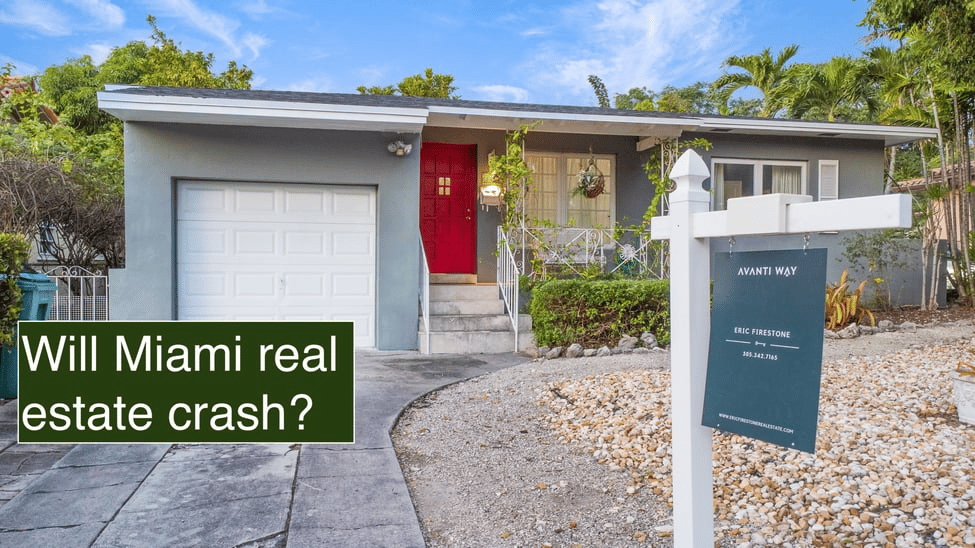
Is a Miami Real Estate Market Crash on the Horizon?
Buying a Home in Miami (or Buyer Tips) Eric Firestone October 10, 2025
Buying a Home in Miami (or Buyer Tips) Eric Firestone October 10, 2025
Many homebuyers I speak with ask the same thing: will the Miami real estate market crash? While 2008 may feel far away, it still looms large in people’s minds.
“What if I buy today and home values crash tomorrow?”
“I see homes expiring every day, isn’t that a sign?”
“Will Miami home prices go down in 2026?”
👉 For a deeper breakdown of why listings stall even with “good exposure,” see:
Why Homes Don’t Sell in Miami (And What Actually Fixes It)
A Miami real estate crash like 2008 is unlikely without forced selling, risky lending, and a major job shock. Prices can still soften in certain neighborhoods or price bands, but most buyers and sellers should plan for a slower market, not a collapse. The best move depends on your timeline, financing, and the specific micro-market, especially in areas like South Miami, Coral Gables, and Pinecrest.
To answer this clearly, it helps to revisit what really happened in 2008, because understanding the why gives you power and perspective.
The 2008 real estate crash wasn’t caused by one bad decision, it was a complex interlacing of multiple industries that created a financial storm. The history books call it The Great Recession, and it was a nationwide crisis, not just a Miami issue.
Here’s a breakdown of the main causes:
Originally designed for high-net-worth individuals, these adjustable-rate mortgages (ARMs) were issued to buyers with poor credit, often encouraging them to purchase homes they couldn’t afford. Many hoped to “flip” the home in a year or two as prices climbed. Some people even repeated this process multiple times in under six months. When the bubble burst, many of these homeowners defaulted or walked away because they could never afford those homes in the first place.
These risky mortgages, combined with artificially low interest rates, led to a speculative boom. Appraisers were under pressure to support rising values, fueling rapid appreciation. But once lending tightened, defaults surged, demand plummeted, and the flood of supply caused prices to collapse.
Lenders bundled these risky loans into mortgage-backed securities (MBS) and sold them to investors under misleading risk ratings. Many of these assets were marketed as safe, when in reality, they were full of high-risk loans.
Investors hedged their MBS risk with insurance products called credit default swaps. But these were also largely unregulated. When things collapsed, insurers couldn’t cover all the claims, deepening the crisis.
Looser oversight let lenders and investors take bigger risks with less transparency. When defaults rose, trust evaporated and credit froze. The lack of oversight across banks, rating agencies, and insurers helped the whole house of cards come tumbling down.
Fluctuations are normal in every industry—and real estate is no exception. Will prices adjust? Yes, in some cases. Sellers who entered the market with unrealistic expectations may need to reduce prices to match today’s demand. But a full market crash?
Highly unlikely.
Here’s why:
Since 2008, governments have added layers of protections. Today’s lending practices are stricter, buyers are better qualified, and financial oversight is much stronger.
After COVID-19, millions of buyers locked in interest rates as low as 2%. Their monthly payments are incredibly low compared to today’s rents and mortgage costs. Most of these homeowners have no reason to sell, unless a personal financial hardship forces them to.
Even those who bought with higher interest rates recently are unlikely to sell. Once rates come down again, they’ll likely refinance, not list their homes. Remember the pandemic? In order to entice people to get back out there and buy again, rates dropped to all-time lows! Surely, we cannot expect to use the same tactic (lowering interest rates) and expect that it will now suddenly entice people to sell! Of course not! Lower rates mean people will refinance and others will buy, thereby creating more demand without increasing supply. As I always say: marry the house, but date the rate. Once you have the house, you can always refinance if the rates go down.
It depends on the home, your timeline, and your goals.
That’s why working with a well-informed and fiduciary-minded real estate agent is more critical than ever. A good agent delivers hyper-local market insights that help you make confident decisions based on your needs, not just headlines.
Every home, every buyer, and every deal is unique. What works for one person may not work for another.
If you are trying to time your purchase, here’s a practical guide to the best time to buy a home in Miami
Today’s Miami market is stable, strong, and resilient. This is our new normal, at least for the foreseeable future.
And real estate, especially in a globally desired market like Miami, remains one of the safest long-term investments you can make.
No, Miami is not in a housing bubble. Homes that are reducing in price are only a reflection of sellers not acknowledging the shift of market from a couple of years ago, not an impending sign of a burst.
Home prices will level and stabilize, when entering the market too high. Those buyers looking for a "drop" however, will be waiting for a very long time, increasing their opportunity cost.
Crashes are drastic drops in prices, as well as drops across the board, throughout all price ranges. Corrections are just price reductions, limited to certain homes or areas, adjusting to market feedback.
Multiple factors would have to occur resulting in a larger amount of inventory to enter the market. This could be from people facing foreclosures due to job losses, increases in costs of living (without increases in salaries), widespread market repairs suddenly needed, interest rates not dropping, causing less options for current homeowners... the list goes on!
It depends. What is your current five-year plan? Most homes do not increase values sharply overnight, it takes time. So, if buying for long-term growth, or equity, think about your five-year plan. If your plan is to not stay for at least five years, then consider your comfort level of renting out your home - do you feel comfortable with renting out your home when you leave to another location if necessary? Becoming a landlord, while also dealing with a long-distance move may not work for everyone. Consult your situation with a qualified agent who can further help evaluate your situation together.
Again, it depends. Compare your holding costs to your sales increases. If you have a future location in mind, that works financially, you may want to continue renting your current home in order to help you increase your long-term wealth. However, the holding cost, such as vacancies, possible rent, maintenance costs and possible management fees may not make financial sense for you to continue holding on to your first property. Again, consult your specific situation with a trusted agent who can further help evaluate your situation together.
In Miami, areas farthest from South Beach, in particular, tend to lose values first. Areas like Homestead and below are usually the last to grow in values, and first to feel any sharp declines.
Miami home prices are not affected as much by interest rates. The constant influx of buyers into Miami, and international buyers seeking stable environments to store their money causes home prices to not be as affected by interest rates. What does get affected are the number of buyers that increase into certain higher price brackets.
As always, look for homes that have long-lasting value, in addition to the homes working for you and your situation. Discuss with your agent what the various micro-markets are for each interested home to determine the potential long-term value for you and your situation. Flexibility in usage, current conditions, upgrades, if any, and future expected costs should all be analyzed when considering a home.
Discuss with your agent your current situation. Ask about the current effects of marketing, what has the exposure looked like, what is the current trending traffic and what are the current promotion plans and strategies? High amounts of traffic, with visible proof, but no requests of showings, indicate the price is too high for the market. High amounts of traffic, high amounts of showings, but no offers often indicate a discrepancy between the expected conditions of the home, and/ or possible agent presentations. (Of course, if the expected conditions are not being met and discourage offers, then the price may also be the issue). Read here for more detailed information on what strong marketing looks like and what a good real estate agent should be telling you.


Get assistance in determining current property value, crafting a competitive offer, writing and negotiating a contract, and much more. Contact me today.