How International Buyers Are Shaping Miami’s Real Estate Market in 2026
Miami Real Estate Market Eric Firestone March 2, 2026
Miami Real Estate Market Eric Firestone March 2, 2026
Miami has never been just a domestic housing market. It’s a global marketplace, and if you’re selling property here, especially a condo, ignoring international buyer behavior is a strategic mistake.
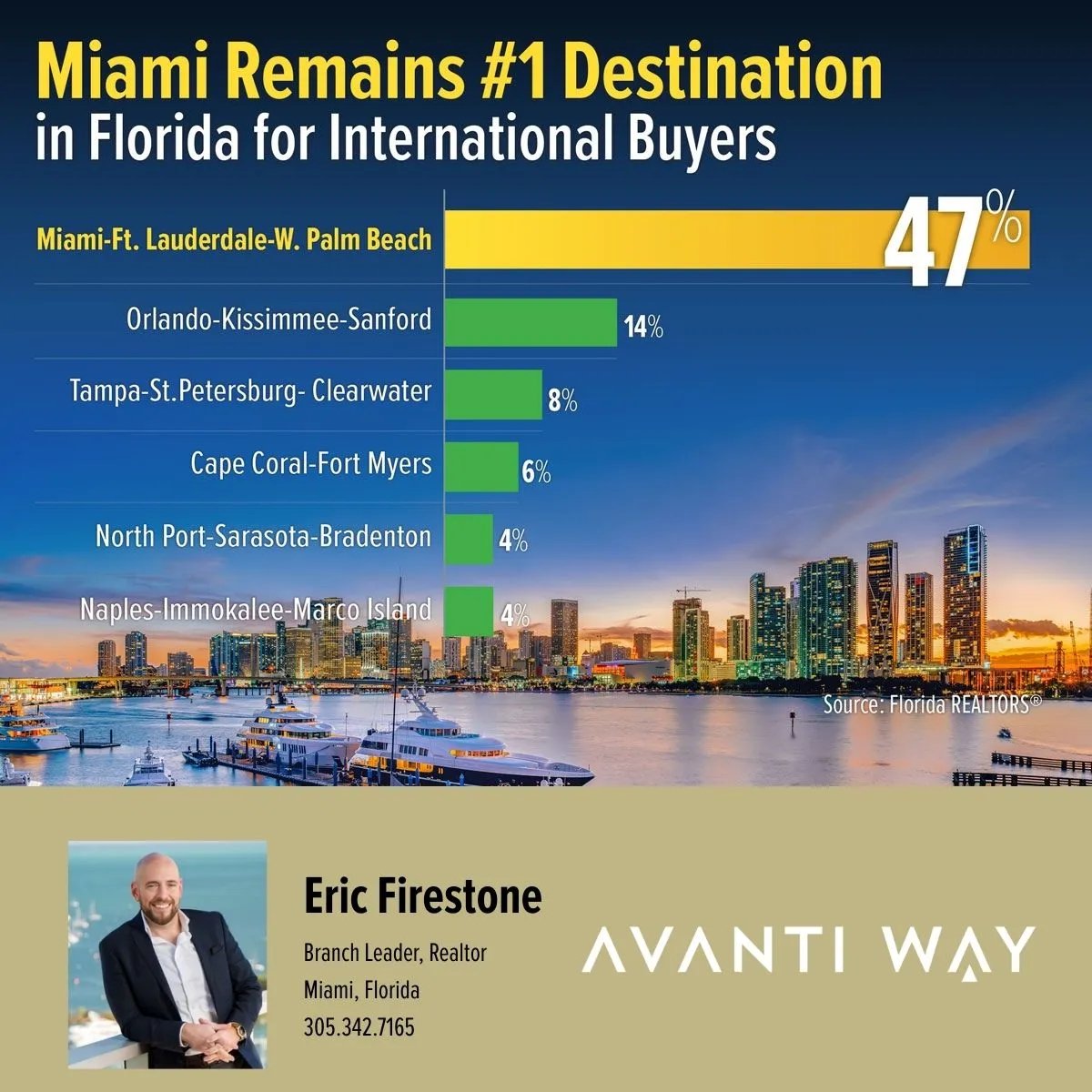
According to the 2025 National Association of Realtors international transactions report, Florida remains the #1 U.S. destination for foreign buyers, and Miami continues to capture a disproportionate share of that demand. Latin America and South America particularly Colombia, Argentina and Mexico, remains one of the strongest sources of inbound capital.
But here’s where most sellers misunderstand the opportunity.
International demand does not automatically mean higher prices.
It means different expectations.
The largest incoming buyer segments influencing Miami today include:
Latin America
South America
Domestic relocations from New York, California, and Texas
For many Latin American and South American buyers, Miami real estate is not just an investment. It’s capital preservation.
The U.S. offers financial stability, stronger banking systems, and predictable property rights. Some buyers are comfortable breaking even on cash flow because their real return is currency security and long-term asset protection.
Others are more return-driven, looking specifically at cash-on-cash yield, rental viability, and building financial health.
These are two completely different buyer psychologies.
If you price without understanding which audience your property appeals to, you’re guessing.
International influence is most obvious in the condo market. Within the same building, subtle differences dramatically impact value:
Floor height
View direction
Natural light
Renovation level
Building reserves and financial strength
Recent Florida regulatory changes have made international buyers far more cautious about reserve funding and building stability. Understanding Florida condo reserve laws and special assessments is now essential before pricing any unit competitively. In many cases, buyers are now:
Asking for special assessments to be paid at closing
Negotiating credits
Reviewing association financials carefully
This is not the 2021 frenzy. Today’s international buyer is analytical.
They compare price per square foot (or square meter), analyze building financials, and evaluate long-term holding costs before making decisions and that analysis directly impacts pricing power. For a deeper breakdown of valuation frameworks, see how to price a Miami condo in today’s market.
Above $1 million, international buyers tend to be even more discerning.
They are looking for:
Unique positioning
Architectural significance
View premiums
Long-term appreciation potential
Below $1 million, buyers are often more yield-focused. Stability, rental viability, and maintenance costs become central.
If you’re pricing and promoting a $1.3M waterfront condo the same way you’d price a $750K rental-driven unit, you’re missing the psychology.
And pricing psychology drives negotiation leverage.
Miami operates as a collection of micro-markets:
Brickell
Edgewater
Coral Gables
South Miami
Pinecrest, and so on.
Each behaves differently, but they are all globally connected.
Miami International Airport and the Port of Miami serve as global economic engines, facilitating corporate expansion, tourism, and international capital flow.
That global connectivity fuels demand, but it also increases competition within specific price brackets. When renovated units enter the market in your building, buyer expectations shift immediately.
And when expectations shift, price must either align… or condition must improve.
The wrong question:
“Are international buyers still buying?”
The right question:
“Does my property align with the expectations of today’s international buyer?”
Because here’s the truth:
If exposure is strong and showings are low, price is wrong.
If showings are strong and offers are low, condition or positioning is wrong.
If international demand exists but your unit sits idle, it’s not the market, it’s the strategy. (In fact, this misalignment is one of the primary reasons why Miami homes expire in competitive micro-markets).
This is where pricing stops being emotional and becomes analytical.
International capital is still flowing into Miami, however, we have not reached pre-pandemic levels yet.
Global buyers are now:
More cautious
More data-driven
More sensitive to building health
More aware of micro-market differences
Price reductions should not happen because “the market feels slow.” They should follow measurable exposure and buyer resistance patterns. When executed correctly, strategic price reductions in Miami create new buyer pools rather than signal desperation. Otherwise, you’re weakening leverage unnecessarily. As Miami continues evolving as a global city, sellers who understand international psychology will outperform those who simply rely on past comparable sales.
That’s the difference between listing a home…
And strategically positioning one.




Get assistance in determining current property value, crafting a competitive offer, writing and negotiating a contract, and much more. Contact me today.